Spark Arresting Solar Technology
Are you aware that a solar panel installation can be a fire ignition source?
Did you know that solar panels can create plasma arcs
that are hotter than the surface of the sun?
© 2015 idealPV, all rights reserved
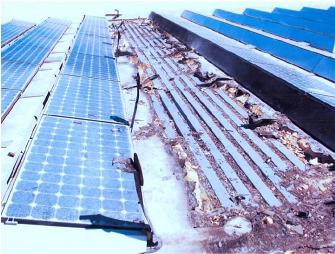
In April 2009, this photovoltaic installation on a commercial rooftop in Bakersfield, CA, suffered serious damage in a fire that started with an electrical arc across a defect in one of the system's inverters. The arc propagated down a string of interconnected panels, consuming and destroying them as it went.
How does a plasma arc form? Almost all substances possess some level of electrical conductivity - even air. And almost anything can be made to conduct electricity if a sufficient voltage is available to drive a current across it. If a current is flowing across a conductor, and the conductor is physically broken, creating an electrical open, an electrical arc will form across the open. Sometimes we see this done in a safe and controlled manner: a neon sign contains a plasma arc, as current flows from one electrode to another through the neon, causing it to glow. The electrical discharge in the neon generates little heat.
But what happens when larger currents travel across the open? A real world case can happen in a typical solar panel. The conductors that carry the panel's power can fracture due to various causes: daily thermal cycling, kinetic stresses from sustained wind or accumulated snow, impacts from objects, etc. The conductors can be in the silicon itself, in the silver or aluminum solder, or in the copper interconnects.
With an IPV, the start of the process is the same, but the arc is immediately suppressed. If a break occurs in one of the panel's conductors, the panel will detect it and operate differently. An ordinary panel will maintain constant current, but an IPV will immediately drop the current.
In the first instant of the fracture, as the open pulls apart, there is a large enough amount of heat concentrated in a small enough volume of space that any of the metals can melt. At the scale of microns, and in the time of a few milliseconds, the heat exceeds 1900 deg F, the melting point of copper. The copper begins to melt, and it produces an orange colored spark. The panel maintains the current that drives the arc, and the heat steadily increases. At 4600 deg F, the copper vaporizes, and a green haze of ionized copper surrounds the arc. The same colors and phenomena can be observed in an industrial arc welder.